


JLPT N5
Vた時 — When ~ ; at the time when ~ (the action or event in the 時[とき] clause is viewed as completed or occurring, and the main clause describes what happens or is true at that time).
~から — Because, since…
~ている。 — Expresses an action in progress (is doing), a state that remains as the result of a change (is on, is open), or a continuing state (lives in, works at).
~てください — Please do ~
~ないでください — Please don't do ~; used to politely ask or tell someone not to do something.
~ました/~ませんでした — Polite past form of a verb: ~ました means 'did (something)', and ~ませんでした means 'did not do (something)'.
~ます/~ません — Polite non-past affirmative and negative verb forms. They describe habits, general facts, and future actions; ます is affirmative and ません is negative.
See more
JLPT N4
~かもしれない — Might ~; may ~; could be ~ (the speaker thinks something is possible but not certain).
~ば — If ~; provided that ~; when ~ (a condition that leads to a result)
あげる — Give B to A (A is a third party, not yourself)
かい — A casual, friendly sentence-final particle that makes a question, like "...?". It is most often used for yes/no questions. With のかい the speaker often asks to confirm something or shows concern.
かた — How to A
かも知れない — Might A, maybe A, perhaps A. The speaker thinks A is possible but is not sure.
がっている — Describes what a third person wants to do or visibly feels: '(he/she) wants to…', 'is showing signs of feeling (afraid, shy, unwilling, etc.)'.
See more
JLPT N3
うち/ないうち — While A is still the case, (do) B. With the ない form, it means 'before A happens', i.e. before the situation changes.
おかげで — Thanks to A, B; owing to A, B (A is the cause of a good result B, and the speaker is grateful for it)
かけの/かけだ — Describes an action that was started but not finished, and was left or interrupted midway. Before a noun it means 'half-done N', such as a half-eaten or half-read item. At the end of a sentence (かけだ) it means 'be in the middle of doing'.
から~にかけて — From A to B; over the span from A to B (a range with approximate, not exact, limits of time or place)
がた — A respectful plural suffix for people: 'you (all)', 'the teachers', 'ladies and gentlemen'.
がっている — Describes what a third person wants or feels, as shown by their behavior: 'X wants to do A' or 'X is showing that they feel A (afraid, shy, etc.)'.
きり — Only/just A; no more than A. This emphasizes that the amount or number is small or limited.
See more
JLPT N2
あまり — So much A that (an extreme or unintended result follows); out of excessive A
あるいは — A or B; either A or B (presenting alternatives). At the start of a sentence with かもしれない it also means 'perhaps' or 'it may be that…'.
うではないか/うじゃないか — Let's A! (a firm, earnest call for the group, including the speaker, to do A)
うる/えない — Expresses that something can happen or can be the case (it is possible in principle). 得[え]ない means it cannot happen or is impossible.
おまけに — On top of that, B; what's more, B (B is another fact added to A)
か~ないかのうちに — Just as A happened or was about to happen, C occurred; hardly had A happened when C occurred.
かいがあって — It was worth doing A; the effort of A paid off (and a good result followed).
See more
JLPT N1
前に — Before doing something, Before (a certain event)
〜ないでください — Please don't
あかつきには — When/once A (a hoped-for or significant event) has been achieved or has come to pass, then B (a result, plan, or promise).
あっての — B exists or has value only because A exists; A is an indispensable precondition for B ('B is only possible thanks to A').
いかんでは,いかんによっては — Depending on N; it all depends on N (how N turns out will change the result or decision).
いかんにかかわらず,いかんによらず — Regardless of N; no matter what or how N is. The result or decision does not change whatever N is (for example a reason, result, age or weather).
うか~まいか — Whether to do A or B (do or not do)
See more
How Yuzunihon works
- 1Find your level
A free 5-minute test shows which JLPT level your grammar is at and which patterns you still miss.
Take the level test → - 2Follow your plan
Pick your exam date and get the lessons to study each day, with meanings, formation and example sentences.
Get your plan → - 3Practise every day
Quizzes and exercises check what you remember and keep your daily streak going.
Try today's quiz →
Weekly Hot
JLPT N1
〜ないでください — Please don't
JLPT N1
Views: 100
JLPT N1
前に — Before doing something, Before (a certain event)
JLPT N1
Views: 10
JLPT N4
ござる/ございます — Very polite, formal form of ある: 'there is / we have / it is located (at)'. It is used for inanimate things, mainly in customer service and business speech.
JLPT N4
JLPT N2
ことから — Because of the fact that A, B. Used for the origin of a name, for reaching a conclusion from evidence ('judging from the fact that A, B'), or for a factual reason behind a result.
JLPT N2
JLPT N2
うる/えない — Expresses that something can happen or can be the case (it is possible in principle). 得[え]ない means it cannot happen or is impossible.
JLPT N2
JLPT N4
かも知れない — Might A, maybe A, perhaps A. The speaker thinks A is possible but is not sure.
JLPT N4
From Our Blog
View all articles


Functions that help your learning more effective
Your Learning Path
Bite-Sized Lessons
Ratings & Comments
Test Your Mastery
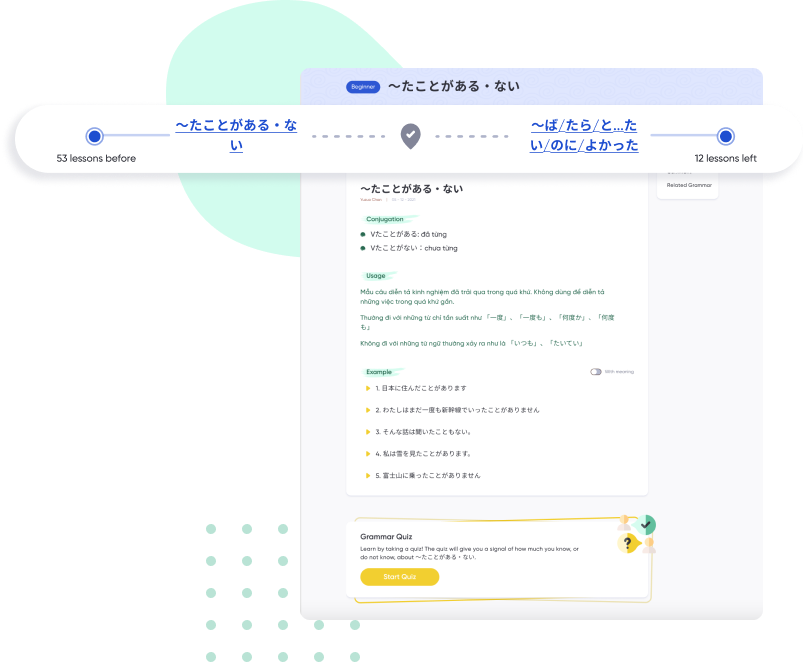
Move easily between the previous and next lessons. Never lose progress.
Learn Japanese Grammar With Us
Access 200+ grammar lessons, quizzes, tools designed to help you learn Japanese faster.
Sign up free